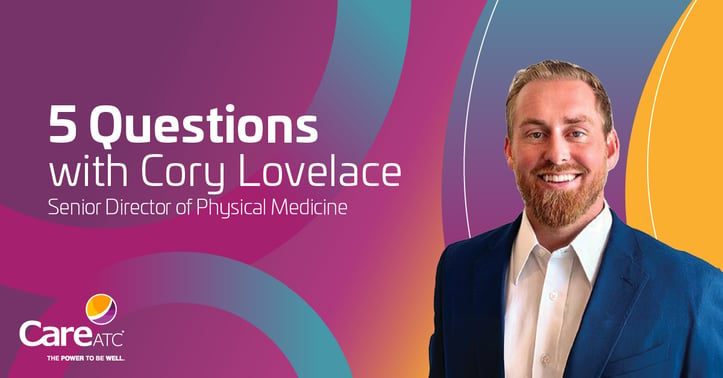
With three years at CareATC and a decade in physical therapy, much of it spent building occupational health programs from the ground up, Cory Lovelace knows firsthand how powerful a well-integrated physical medicine program can be. We talked with him about why physical therapy deserves a bigger seat at the table in workplace health strategy, how CareATC's one-on-one care model is changing outcomes for both patients and organizations, and what it really takes to shift from reactive injury care to proactive prevention.
1. Why is physical therapy such a critical and often overlooked part of a comprehensive workplace health strategy?
There's a statistic out there that was done by the National Institute of Occupational Safety and Health, and it said that for people that start physical therapy later than 14 days after the onset of an injury, the time and cost of recovery goes up by 25%. I think when it comes to why it is such a critical and often overlooked role, having a physical therapist specifically on site is great in providing quicker access to care so that patients can really streamline their recovery process and reduce their rehab time.
Physical therapy isn't just meant to be an ancillary service. It's meant to be in the forefront so that people can start the recovery process faster. This is true not just for orthopedic injuries, but nervous system related injuries and everything else. The quicker you get into physical therapy, the quicker your body starts to relearn some of the things that it lost. Your body loses muscle mass quicker than it gains it. If someone doesn't use a muscle for, let's say, a day, it would take about 3 days to get it back to where it was. Physical therapy is very critical in that whole recovery process, because if you’re starting to rehab some of the injuries, it's going to get you better a lot faster than if you were to just sit there and wait for physical therapy to happen later.
2. What are the biggest misconceptions people have about physical therapy, and how does CareATC work to change that?
This is one of the best things about CareATC. Coming here, there wasn't much emphasis on physical therapy three years ago, and it's been very rewarding to build it into the true scope of what physical therapy is. When people think of physical therapy, they think of, “I got injured, I can't move my arm, I can't walk, I'm going to go get treatment after the fact,” which is true. Injury care is a huge part of our scope. However,not many people know that there's a lot more to our scope of practice when it comes to injury prevention and when it comes to overall musculoskeletal wellness. We do a lot more than just teach people to walk and to use their arms again, and it's a lot more than just exercise. We do maneuvers and techniques, from hands-on therapy to using modalities like electrical stimulation, cupping, and dry needling. We also do a great job at translating that into our patients’ functional day-to-day life.
But the other half of our scope is that injury prevention and wellness component. I would love to get to the point where people start using physical therapy like they use their primary care physicians, like having an annual physical. There's a lot of things that PTs can do in a predictive manner and not just a reactive manner for injury care, like specific screenings that can predict if someone's going to get injured in the next six months. I think CareATC does a great job at allowing our department to structure that into our programs. Being able to work in an onsite clinic with other providers and having the physicians there on-site allows for better communication. If someone is in for a physical with the provider, the provider may see a slight concern and get them over to the PT quickly to have a more in-depth musculoskeletal exam. CareATC provides a great platform and opportunity for physical therapists to employ their full scope of practice instead of just injury care, which is realistically only about 50% of what they're capable of doing.
3. What makes CareATC's approach to physical medicine distinct from what employees might experience through a traditional insurance plan?
This is my favorite question. For a typical physical therapist, a lot of clinics they’d work in are focused on making money. They expect their physical therapists to see three or four patients at the same time. A lot of times, the physical therapist will only have about 5 to 10 minutes with that person to do manual therapy or something that's a little more personal to them. Otherwise, it gets very monotonous as a physical therapist when someone has a knee injury for example, and you’re just going to give them the same list of 10 exercises that you give to everyone with a knee injury. The PT is not giving them feedback on the movement themselves and is just hoping that they do their sets and reps that you’ve asked them to do.
At CareATC, the culture and the model that's been built here is the ideal, dream scenario for any physical therapist. We don't keep track of what units are billed. We don't care if we're billing the most expensive, reimbursable unit possible. We care about the patient, and we care about what kind of treatment they're receiving for their specific injury. And we do it in a one-on-one model. Every patient, when they schedule an appointment, can be sure that they are only going to be seeing a physical therapist with no other patients around. That physical therapist follows them for an hour during their session, giving them feedback on specific exercises, being able to say, “you know what, we have been doing this exercise, it doesn't seem to be working.
and let's try something new.” The ability to provide a one-on-one care model for the patient is ideal, because they get that feedback and their recovery is a lot faster. This shows up in our metrics, where the average visit length from evaluation to discharge in traditional settings is about 10.5 visits. Here at CareATC, it's about 5.4. About half as many visits are needed to get someone better and back to their normal selves out in the community. I attribute it a lot to being able to focus on the patient at every session that they come to.
4. What can organizations do at a structural level to prevent injuries and build a culture that prioritizes physical health before people get hurt?
I think awareness is the biggest thing. There's so many risks out there, and especially in the work setting, where individuals might not be used to a manual labor job and aren't used to performing physical activities like lifting, pushing, and pulling. A lot of those techniques have a specific manner in which they should be performed to prevent injury. Ideally, organizations set it up in a way where there’s proper training and awareness of that. At CareATC, we have our Work Smart model. It's our injury prevention and early intervention model for occupational health, and it focuses on a whole spectrum of injury prevention programs that do just that. It teaches body mechanics and does ergonomic assessments. They do these things called Gemba walks where they get a group of people from the organization to walk around, talk to employees, and see what's working, what's not, and assist in different ideas to set up the workplace environment more safely and appropriately. The program is typically run by an athletic trainer. It's within their scope to provide injury prevention and early intervention, as well as triage early musculoskeletal complaints. There’s a lot of different programs for different settings, because something might be more beneficial in a manufacturing setting versus a municipality versus an energy company. But I think the theme that goes across all of them is providing education and awareness to the employees of proper mechanics of safe working habits.
5. Can you share a moment where CareATC's physical medicine support genuinely changed things for an individual or an organization?
I'll give two quick examples. The organization-level one first. We started our Work Smart program using a physical therapist at this manufacturing site, and it got to be very successful. They started seeing their workers' comp claims reduce significantly. The claims were reduced by 83% in the first year, and then they continued in the second year with a 79% reduction. They were averaging about 24 injuries at work per year that were related to musculoskeletal injuries. And then it reduced to 11, and then it reduced down to seven and five the consecutive years. A physical therapist was there providing early education and injury prevention programs specific to this manufacturing company. It got to be so popular and busy that by the second year, they hired an athletic trainer to expand and do that exact job. The cost alone that we saved them was around $1,000,000 in workplace injury costs per year.
That's how it's helped out an organization. But when it comes to helping out individuals, there’s another example I wanted to share. We do “moments that matter” at CareATC. We start with these during our monthly department meetings for physical therapy, sharing real life scenarios that have happened in our clinics, and there was kind of a theme last month. There were a couple of therapists that shared very similar stories where they just happened to be around the front desk when the patient came in for the first time to try to schedule an appointment. The therapists had time on their calendar and said, “you know what, it sounds like it's something musculoskeletal-related, let's just get you in.” This one patient at one of our California sites came in thinking they injured their ankle pretty significantly. They were going to go to the emergency room to get x-rays and thought it was broken. The physical therapist said “I have time. Come back and I'll get you in right now.” So they came back and he did a bunch of tests to make sure it wasn't broken, to see which ligaments and things were involved in the sprain. The therapist gave them some basic advice of how to reduce the swelling, gave them some exercises and some other techniques to do at home, then scheduled a follow-up appointment for a couple of days later.
A couple of days later, the person came back and was very happy that they didn't go to the emergency room. They were already getting better from the exercises and techniques that the physical therapist taught them to do. The recovery ended up only needing another week after that to be fully back to function. That was just one of the many times where those sorts of things happened. Having a physical therapist there to streamline someone's recovery process is one of the biggest benefits of having a PT on the team. It gets people in faster, it promotes a quicker recovery, and people are just happier afterwards. You might be in pain during the PT session, but that's all for good reason. I say this as a physical therapist, but I really think that CareATC has hired some of the best PTs out there. We have a really good team here, and they all bring a lot of knowledge and background to the organization. I think the model that's been set up provides our physical therapists opportunities to be engaged on a more proactive level, getting people in and being a part of the team so that a patient's journey through recovery is a lot smoother and a better overall process.